What Your Pet's Ashes Can Reveal: The Science Behind Memorial Artwork
When people first hear about what we do at Ashes to Artworks, the most common reaction is curiosity mixed with skepticism. "There are patterns in pet ashes? Real patterns, or is this just creative photography?"
It's a fair question. We live in an age of filters and AI-generated art, where it's hard to know what's authentic anymore. So let me walk you through exactly what happens when you send us a small amount of your beloved pet's cremated remains.
It Starts With Chemistry, Not Camera Tricks
Your pet's ashes aren't just uniform gray powder. They contain a complex mixture of elements - the physical building blocks that once formed bone, tissue, and life itself. Each animal's composition is unique, influenced by their diet, their environment, their health history, even the water they drank throughout their life.
We've spent years developing a proprietary laboratory process to extract and concentrate specific compounds from these ashes. This involves multiple phases: cleaning, buffering, extracting, and concentrating. The entire chemistry process takes about two hours of active work, with waiting periods between each phase.
What we end up with is a concentrated solution that carries your pet's unique chemical signature.
Growing Crystals: Where Science Becomes Art
From that concentrated solution, we grow crystals.
This isn't metaphorical. We're literally creating crystalline structures in our climate-controlled laboratory. How these crystals form - their geometry, their internal structure, the way they develop - depends entirely on the chemical composition we extracted from your pet's remains.
A dog who lived in one part of the country will have different trace elements than one who lived elsewhere. A cat who ate primarily fish-based food will have a different composition than one who ate poultry. These differences matter. They influence crystal formation in ways that are small but significant.
The process takes several hours, sometimes longer depending on the specific chemistry we're working with. We can adjust temperature and other variables to influence growth rate, but we can't control what patterns emerge. That's determined by what your pet's body contained.
Polarized Light: The Moment of Revelation
Once crystals have formed, we move to the microscope.
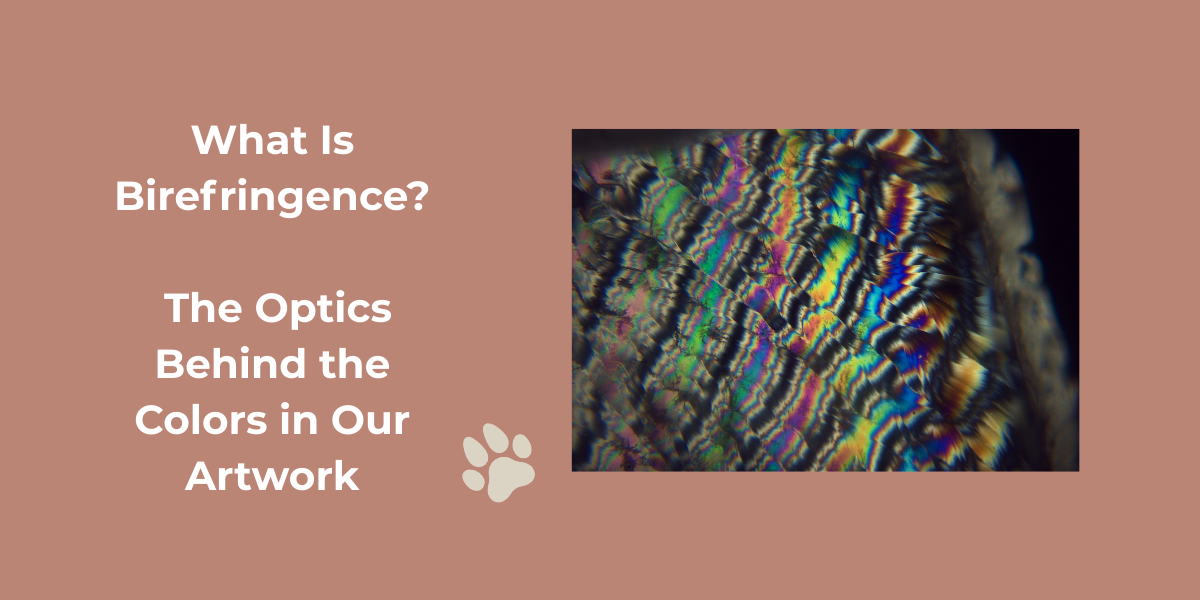
We use an inverted phase contrast microscope with polarizing filters - the same type of equipment geologists use to identify minerals and study rock formations. When polarized light passes through crystalline structures, something remarkable happens.
Different molecular arrangements cause light to bend at different angles. Some wavelengths pass through easily. Others bend, split, interfere with each other. What emerges on the other side is color - not added by us, not enhanced by software, but created by the fundamental physics of how light interacts with matter.
We spend 3-4 hours with each pet's crystals, systematically exploring different angles, different lighting conditions, different areas of crystal formation. We're looking for the moments when the patterns are most striking, most distinctive, most... them.
Why Every Pet Creates Different Patterns
This is the question we get asked most: "How do you know these patterns are unique to my pet?"
Because chemistry doesn't lie.
The crystal structures we grow are direct expressions of your pet's physical composition. Two different animals will virtually never produce identical patterns because their chemical makeups are different. Even littermates who ate the same food and lived in the same house will have variations.
Think of it like a fingerprint, but instead of skin ridges, it's the elemental signature of a life lived. The calcium that formed their bones, the trace minerals that accumulated over years, the compounds that made them physically who they were - all of this influences how crystals form and how light moves through them.
If we processed the same pet's ashes twice, the patterns would be similar - you'd recognize they came from the same source - but not identical. Crystal formation has natural variability, just like snowflakes from the same cloud are similar but not clones.
What You Actually Receive
After all of this - the chemistry, the crystal growth, the hours of observation - you receive four high-resolution digital images.
These aren't snapshots. They're archival-quality photographs suitable for printing at museum-grade standards. You can frame them, share them with family members, print them at any size, keep them digitally forever.
Some people frame one large print for their home. Others print all four and create a gallery wall. We've had families print small versions for keepsake lockets. One client printed hers on canvas and donated a copy to the veterinary clinic where her dog spent his final day, as a way of saying thank you.
The images are yours to use however brings you comfort.
The Question of "Why"
The practical explanation of our process is straightforward: chemistry, crystallography, optics. But that doesn't answer the deeper question people are really asking when they reach out to us.
Why would someone want this?
After a pet dies, you're left with physical remains that feel both precious and impossible. An urn on a shelf. Ashes you can't quite bring yourself to scatter. A cremation box from the veterinarian that you hide in a closet because seeing it hurts too much.
We can't bring them back. Nothing can. But what we can do is reveal something about them that you've never seen before - something that was always there, in the physical structure of who they were, but invisible until now.
When people receive their images, they often tell us it feels like discovering a secret their pet left behind. A way of saying "I'm still here, just differently."
One client described it this way: "It's not that I needed proof that she mattered. I know she mattered. But seeing that her body - even after death - can still create beauty... it made the grief feel less like an ending and more like a transformation."
Not For Everyone, And That's Okay
This service isn't for everyone, and we're upfront about that.
Some people find deep comfort in traditional memorials - a burial plot, scattered ashes in a meaningful place, a simple urn on the mantle. Those are beautiful, honored ways to say goodbye.
This is for people who need something else. Something tangible but not physical. Something scientific but not cold. Something that acknowledges both the reality of death and the persistence of... something. Light, pattern, beauty, memory - whatever word feels right to you.
We work with about 20-25 pet memorials each month. That number is intentional. Each one requires hours of focused laboratory work and observation. We could scale up, hire assistants, systematize the process for volume. But then it would become manufacturing instead of what it actually is: patient attention applied to individual loss.
The Grief No One Warns You About
Here's something we've learned from hundreds of conversations with grieving pet owners: people are often surprised by how deeply losing a pet affects them.
Friends who've never had animals don't quite understand. Coworkers expect you to be "over it" after a week. There's this cultural message that pet grief is somehow lesser than other losses - that you should be sad for a bit, then move on.
But anyone who's loved a pet knows the truth. They were there for your whole life - or at least, the part of your life when you needed them most. They saw you at your worst and stayed anyway. They asked for so little and gave you everything they had.
When they die, the absence is enormous.
We can't fix that. But what we can do is create a space where your grief is taken seriously. Where the fact that you want to invest time and money into honoring your pet's memory is treated as completely rational, because it is.
Your grief deserves more than a condolence card and a week of sadness. It deserves whatever helps you heal.
What Happens Next
If you're reading this and thinking about whether this might be right for you, here's what we recommend:
Sit with the idea for a while. There's no rush. Your pet's ashes will be just as viable in a month, a year, five years as they are today. Crystal formation doesn't depend on freshness.
If it still feels right after you've had time to think, reach out. We'll have a conversation about your pet, what you're hoping this memorial might provide, whether this feels like the right fit. No sales pressure, no scripts. Just honest discussion.
If you decide to move forward, you'll send us one teaspoon of ashes - less than 1% of typical cremated remains. We'll document everything, keep you updated on timing, and deliver your images within 3-4 weeks.
And if you decide this isn't for you? That's completely okay too. Grief is personal. What helps one person might not help another. We're one option among many.
A Final Thought
Every pet memorial we create starts the same way: a small amount of ash in a container, sent to us by someone who loved deeply and lost painfully.
What ends up emerging - the crystal patterns, the colors, the unexpected beauty - is different every single time.
We've done this hundreds of times now, and it never stops being remarkable. The fact that what looks like uniform gray ash contains this hidden complexity. That the same elements that formed life can, through careful chemistry and patient observation, create light.
Your pet may be gone. But the physical reality of them - the actual matter that made them who they were - can still create something beautiful.
Sometimes, that's enough to make the grief a little more bearable.
Interested in learning more about the process or seeing samples of memorial artwork? Visit ashestoartworks.com or email us at support@ashestoartworks.com. We donate 5% of every purchase to local animal shelters, because the best way to honor the pets we've lost is to help the ones still waiting for homes.
Ashes to Artworks Blog